Robot Actuator Working Principle: How Electricity Becomes Precise Motion
The easiest way to understand a robot joint is to look at your own body. Your arm bends, your wrist rotates, your knee flexes — every movement is the result of muscles, bones, and nerves working together. Robot joint design is, at its core, an imitation of that system: motors replace muscles, metal structures replace bones, and chips with algorithms replace nerves. But "how does it work" cannot be answered with "a motor drives a gearbox." A modern integrated joint module is a complete small system, and this article explains it along two threads: the flow of energy and the flow of signals.
What a Robot Actuator Actually Does
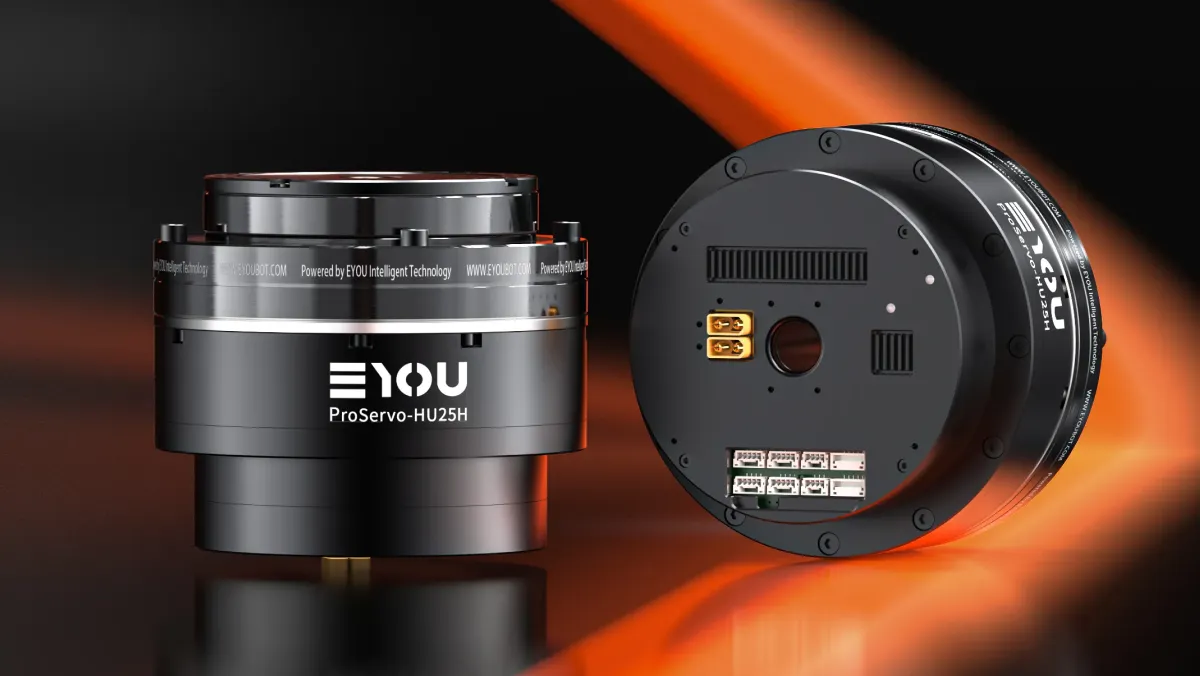
The definition is simple: an actuator converts electrical energy into controlled mechanical motion. Simple — and misleading, because the hard part is "controlled." Open up an integrated joint module and you find a motor, a reducer or a lead screw, a drive, encoders, and structural parts packed into one unit; only together do they form a complete power component (for the detailed breakdown, see What Is Inside a Robot Actuator; for basic definitions, see What Is a Robot Actuator).
The motor is the power source, and its role is closer to a heart than to a brain. Robot joints commonly use frameless torque motors: no conventional housing, with the rotor and stator embedded directly into the joint structure to extract more power from tighter space. But a motor has an inherent limitation — it spins fast, yet it cannot deliver high torque directly, and free spinning does no work. That weakness is what the transmission exists to solve.
The Energy Flow: From Current to Joint Torque
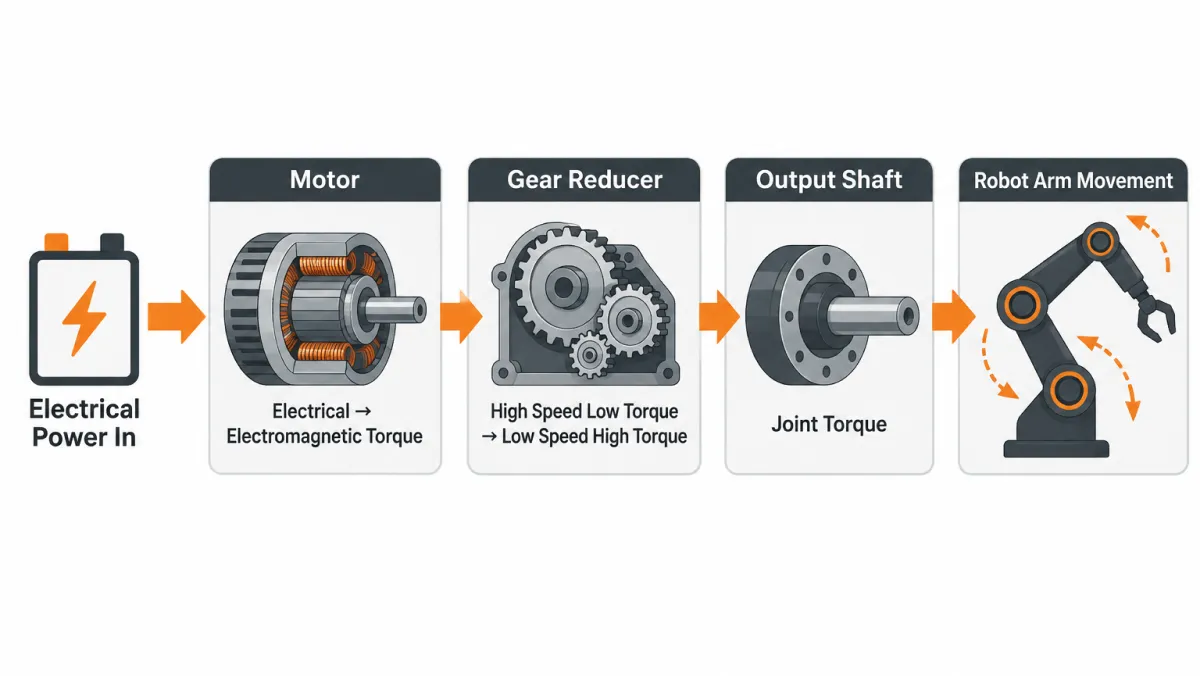
The energy flow follows a four-stage conversion chain. Current enters the motor and generates electromagnetic torque between stator and rotor — the output at this stage is fast rotation with low torque. The reducer then trades that speed for force: it brings rotation down from tens of thousands of rpm and multiplies torque in return. The output shaft finally drives the load at low speed and high torque, turning electrical input into a physical movement of the arm. A joint that can slow down gains precision and stability — and only then does lifting, carrying, and payload work become possible.
Linear joints follow the same chain with a different final stage: instead of a reducer, a precision screw converts the motor's rotation into linear motion along a fixed axis, with high axial force and strong shock resistance. Body parts that extend rather than rotate — a humanoid's knees and elbows — use this route.
The Signal Flow: How the Closed Loop Corrects Itself
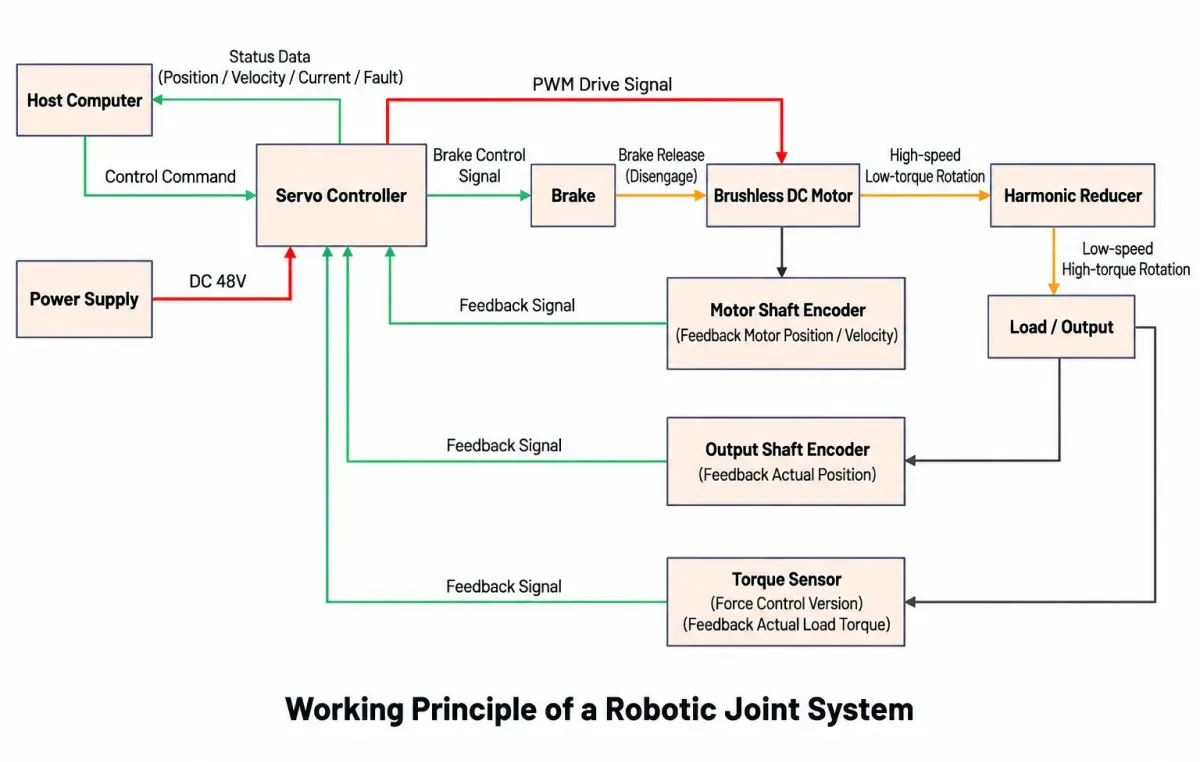
The energy flow makes a joint move; the signal flow makes it move accurately. The drive is the brain hidden inside the joint: it receives the motion command from the host controller — "move to 30 degrees" — reads the encoder's feedback on the current position, computes the difference, and decides how much current to apply to the motor and in what manner. Command, actuation, feedback, correction — the loop repeats in milliseconds. That is closed-loop control.
The hardware foundation of this loop is the encoder. EYOU's harmonic and planetary joints use dual absolute encoders: one on the motor shaft and one on the output shaft, at 19-bit resolution. The first measures motor speed; the second measures the true output position after the reducer, so any transmission error is caught and corrected. At the drive level, EYOU develops its own joint-specific control chip, with hardware-based FOC algorithms and millisecond-level force control, achieving over 70% terminal energy efficiency. The core idea of FOC (field-oriented control) is to keep the stator's magnetic field perpendicular to the rotor at all times, so every ampere of current produces useful torque (TI technical documentation).
Three Transmission Routes, Three Different Mechanisms
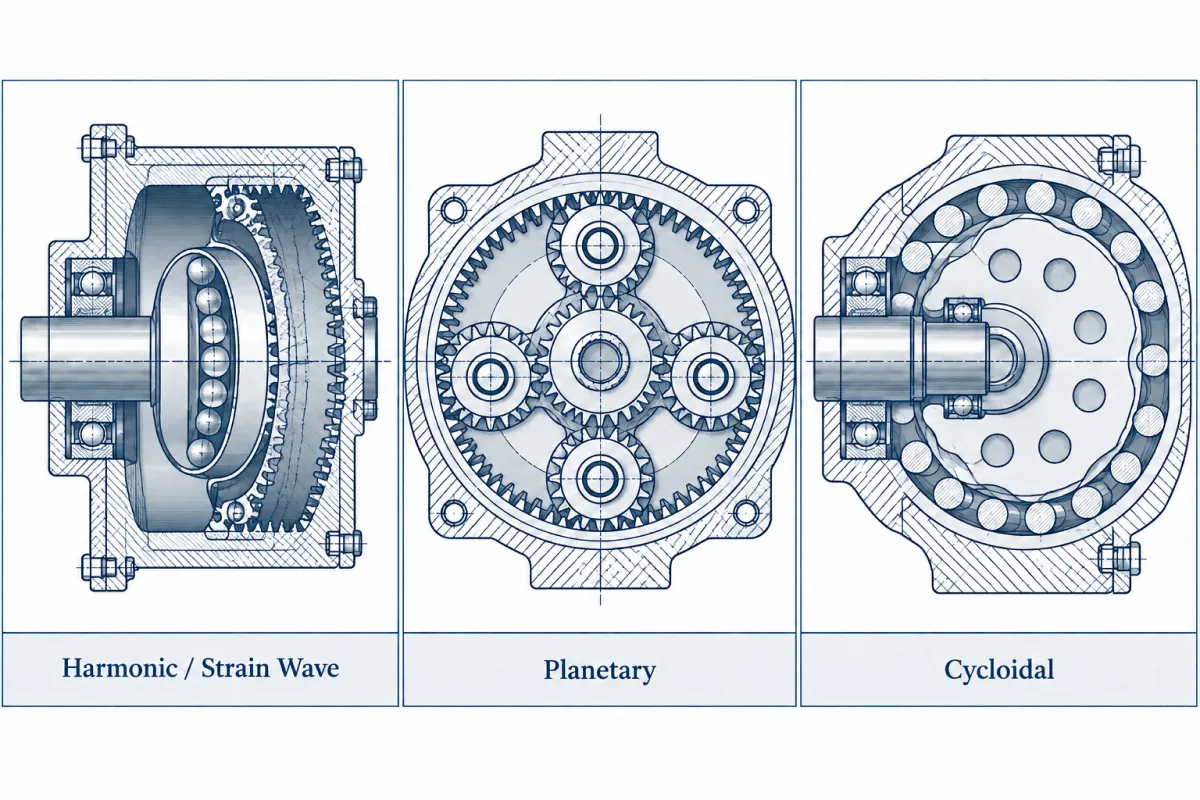
The core difference between rotary joints lies in the reducer, and there are three main technical routes — each with a completely different physical mechanism.
A harmonic reducer consists of three elements: a wave generator, a flexspline, and a circular spline. The elliptical wave generator sits inside the thin-walled flexspline and forces it to deform elastically, so its external teeth mesh tightly with the circular spline's internal teeth at both ends of the major axis. The circular spline has only two more teeth than the flexspline, so one full turn of the wave generator moves the flexspline by just two teeth in the opposite direction — a large reduction ratio in a single stage. Because the teeth stay in constant tight contact, there is no free play: that is where zero backlash comes from (Harmonic Drive technology page). High precision in a minimal package makes harmonic joints nearly irreplaceable for space-constrained positions like forearms, wrists, and hands (for a deeper look, see What Is a Harmonic Drive).
A planetary reducer is structured like a miniature solar system: a central sun gear driven by the motor, three or four planet gears meshing with the sun on one side and a fixed ring gear on the other, each planet spinning on its own axis while orbiting the sun, with power finally delivered through the planet carrier. The load is shared across multiple planet gears at once, so each tooth carries far less force — the source of its shock resistance and rigidity. The trade-off is a small amount of backlash between the teeth, a different precision regime from harmonic. A cycloidal reducer sits between the two: an eccentric shaft drives a cycloidal disc in a circular oscillation against fixed pins, offering better shock resistance than harmonic and better volume and precision than planetary — a combination long proven in heavy-duty industrial robots.
How Humanoid Robots Raised the Bar
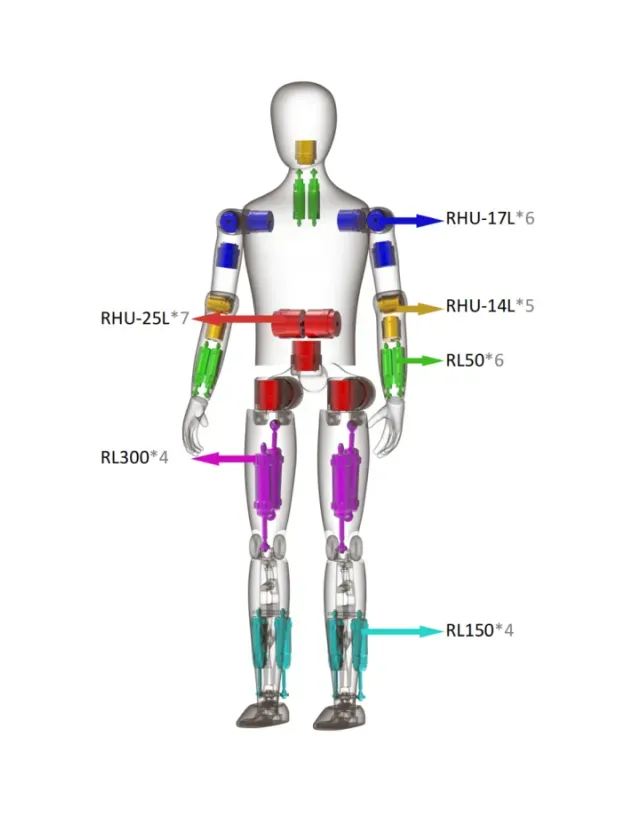
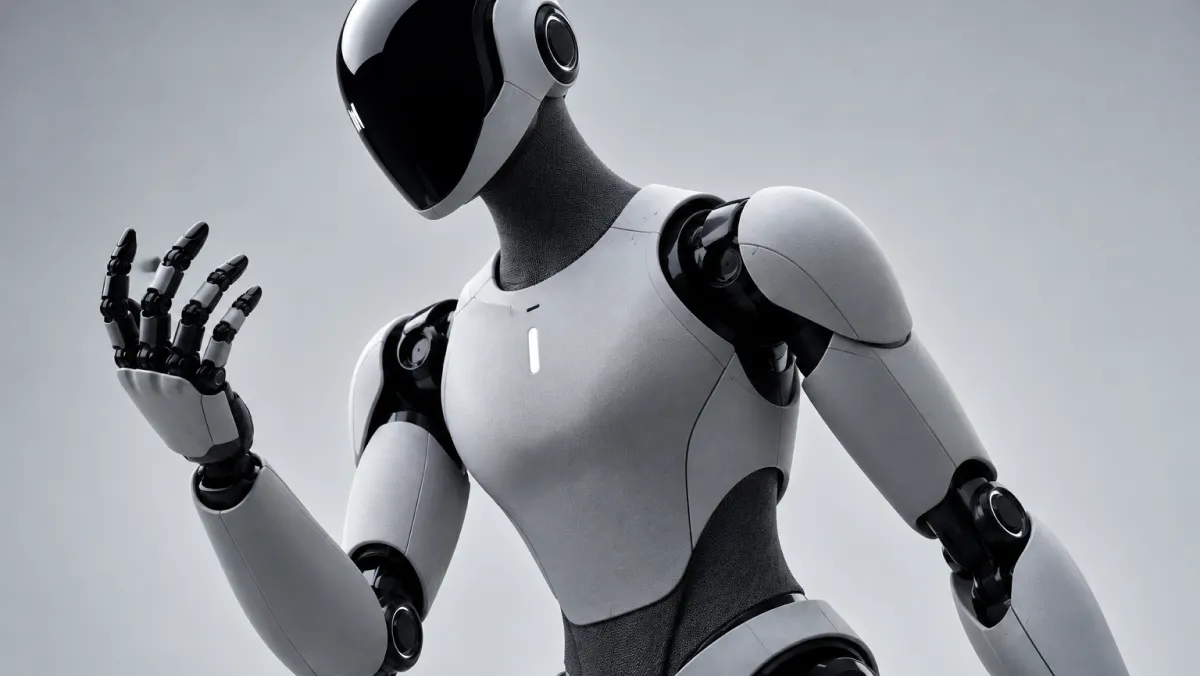
A full-size humanoid typically carries twenty to forty joints, and they are connected in series — the forearm joint lifts the payload, the upper-arm joint lifts the forearm plus the payload, and every joint's weight and performance is multiplied upstream. Tesla's Optimus uses 28 structural actuators in 6 designs, mixing 3 rotary and 3 linear types (humanoid.guide). Rotary-plus-linear, customized by body position, has become the standard architecture of humanoid joints.
At the design level, humanoids have split actuator development into two branches. One is the high-reduction route — harmonic and planetary — built for stiffness and precision. The other is quasi-direct drive (QDD), which cuts the reduction ratio below 10:1 and trades torque density for backdrivability and high-bandwidth force control: MIT's Cheetah robots used a single-stage 1:5.8 planetary transmission with current-based torque estimation, achieving proprioceptive force control with no torque sensor at all (MIT paper; arXiv review; UCLA's systematic comparison of four actuator paradigms: paper). Neither route is superior — they serve different body positions.
Where the Principle Ends Up: Products
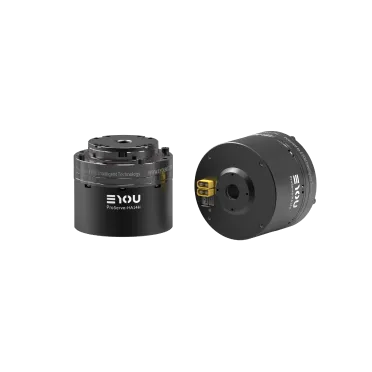
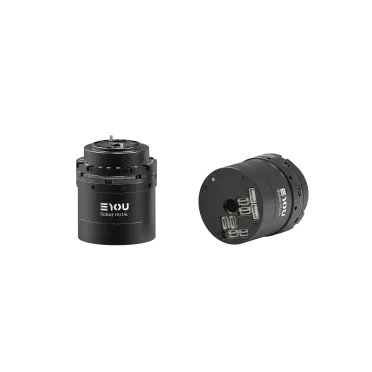
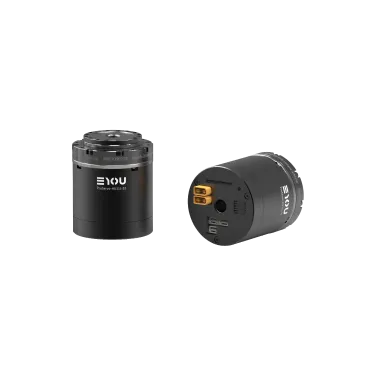
Put the two threads together. The energy flow answers where the force comes from — the motor generates torque, and the reducer or screw transforms it. The signal flow answers where the accuracy comes from — the drive, FOC, and dual encoders closing a millisecond-level loop. The choice of transmission route decides which part of the robot the joint belongs in. EYOU's mass-produced joints are organized around exactly this logic: the RHU humanoid harmonic actuator serves high-precision upper-body positions with zero-backlash strain wave gearing, the RP humanoid planetary actuator serves impact-loaded legs with a planetary route, and the RL linear actuators cover the knees and elbows with precision screws. If you are designing a humanoid or a collaborative arm, send the torque, precision, and space constraints of each position to our application engineers.
FAQ
A motor only converts electrical energy into rotation. A robot actuator is a complete system: motor, reducer or screw, drive, encoders, and structural parts in one integrated unit. The motor makes things spin; the actuator delivers controlled motion — torque multiplication, position feedback, and closed-loop correction all happen at the actuator level.
Three types by energy source: electric, hydraulic, and pneumatic. Hydraulics deliver high power with complex supporting systems; pneumatics are cheap but imprecise; electric actuators dominate collaborative and humanoid robots because of their control precision, simple maintenance, and natural fit with digital control. The joint actuators discussed in this article are all electric.
Speed reduction and torque multiplication. A motor spins fast but cannot deliver high torque directly; the reducer brings the speed down from tens of thousands of rpm and multiplies the torque in return, so the joint can move slowly, precisely, and under load. In linear joints, a precision screw plays this role — converting rotation into linear motion.
Closed-loop control is a repeating cycle of command, actuation, feedback, and correction: the drive receives a target position, encoders report the actual position in real time, and the drive adjusts motor current to close the gap. Without the loop, the joint cannot know whether it reached its target, and load changes or transmission errors turn directly into motion errors.
A harmonic reducer works through elastic deformation of a flexspline meshing with a circular spline that has two more teeth — single-stage high reduction with zero backlash, leading in precision and compactness. A planetary reducer shares load across multiple planet gears around a sun gear — strong in shock resistance and rigidity, with a small amount of backlash. A cycloidal reducer uses an eccentric shaft driving a disc against fixed pins — tougher than harmonic, more compact and precise than planetary, a middle route. The choice depends on the body position, not on an absolute ranking.
Encoders record the joint's position and speed in real time — they are the feedback source of the control loop. A single encoder on the motor shaft cannot see transmission errors introduced by the reducer. Dual encoders add a second sensor on the output shaft, measuring the final position directly so transmission error is corrected inside the loop. EYOU joints use dual absolute encoders at 19-bit resolution, with no re-homing needed after power loss.
A full-size humanoid typically carries twenty to forty joint actuators. Tesla's Optimus uses 28 structural actuators in 6 designs (3 rotary plus 3 linear); EYOU's 1.7 m humanoid configuration uses 32 joint modules. The exact count depends on how many degrees of freedom the arms, waist, neck, and legs are designed with.
A quasi-direct drive (QDD) actuator keeps the reduction ratio below 10:1, trading torque density for backdrivability and high-bandwidth force control — external force can back-drive the joint, and output torque can be estimated from motor current, eliminating the need for a torque sensor. MIT's Cheetah robots validated this route with a single-stage 1:5.8 planetary transmission, suiting leg joints that interact with the ground and absorb impacts constantly.