How to Improve Robot Actuator Power Density: Four Engineering Levers
Robot joint design has always chased one goal: more power output from smaller volume and lighter weight. The combined measure of that goal is joint power density. Improving it is fundamentally an exercise in optimizing power, space, and weight together. This article walks through four engineering levers — coaxial integration, reducer miniaturization, topology-optimized housings, and motor slot fill — and explains how each one moves the number.
What Are Power Density and Torque Density?
Power (P) is torque (T) times angular velocity (ω): P = T·ω. For joints, which work mostly at low speed and high torque, engineers more often talk about torque density: how much torque a unit of weight (Nm/kg) or volume (Nm/L) delivers. One more distinction matters before comparing numbers: peak torque lasts seconds, while continuous torque defines what a joint can do all day. Comparing the power density of two joints only makes sense after aligning on peak versus continuous.
Why Humanoids Pushed Power Density to the Front
A humanoid robot typically carries twenty to thirty joint actuators connected in series: the forearm joint lifts the payload, the upper-arm joint lifts the forearm plus the payload, and the hip and knee joints carry everything above them. Every gram of joint weight is multiplied upstream. Leg joints face peak torque demands and battery-life pressure at the same time. Power density has therefore become the first metric of a humanoid joint — which is why integrated joint designs keep proving themselves in the literature: a coaxial integrated joint prototype published by HKUST(GZ) in 2026 measured 35.7 Nm/kg of torque density (arXiv paper).
Lever 1: Coaxial Integration — Compress the Joint First
A complete joint module integrates a motor, a reducer, a drive, and encoders. If these components sit separately in a scattered layout, the result is a long axial package, a heavy assembly, and substantial transmission losses and signal latency — all of which drag down effective power output.
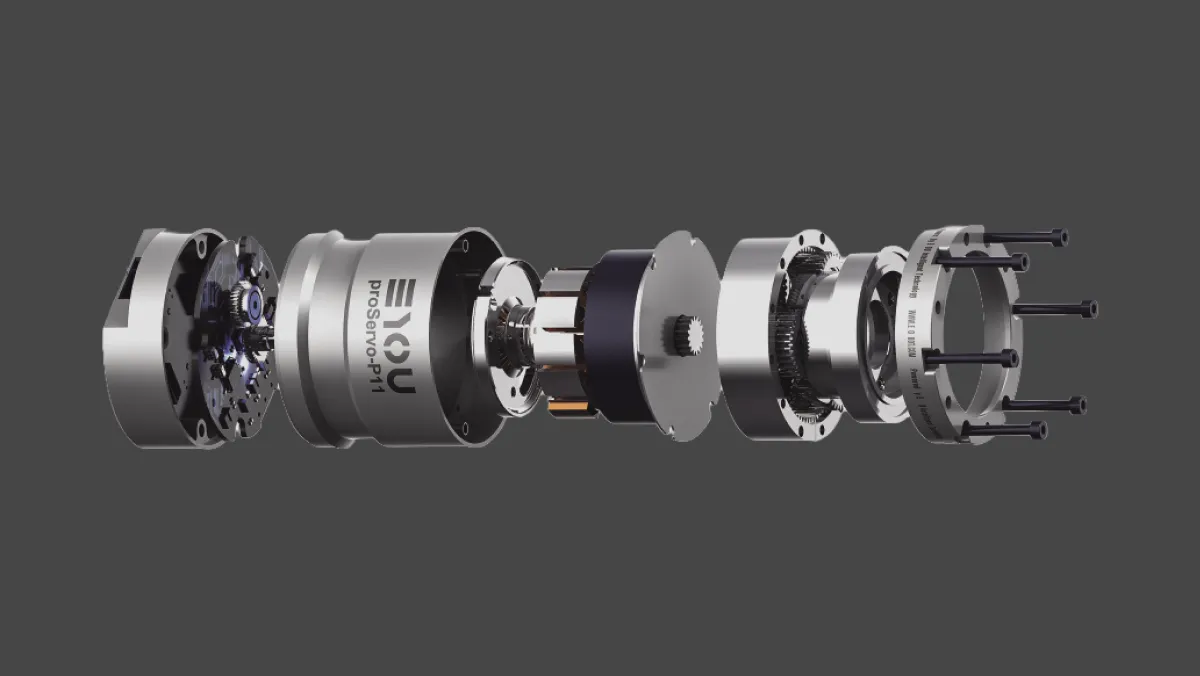
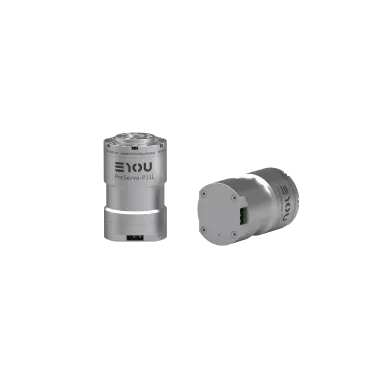
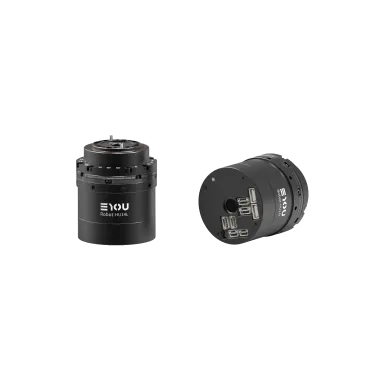
EYOU joints abandon the traditional assembly approach and integrate the motor, reducer, drive, and encoders on one axis. The axial length is compressed to its limit, cutting mechanical transmission losses and dead weight. The physics supports this direction: MIT's classic quasi-direct-drive research showed that motor torque density scales with roughly r0.8 of the air-gap radius, and torque efficiency with r4.1 — a large-diameter, flat coaxial layout is physically the optimal shape for power density (MIT paper). The practical result is just as direct: the RHU humanoid harmonic actuator delivers the same torque in a volume 30% smaller than conventional designs, fitting the compact requirements of lightweight humanoids.
Lever 2: Reducer Miniaturization
The reducer handles speed reduction and torque multiplication — and it is also the biggest contributor to the joint's weight and volume. EYOU iterates its self-developed planetary reducer toward miniaturization, using ISO 1328 grade-6 precision gears to keep backlash low, noise down, and motion consistent while trimming surplus structure into a smaller transmission unit. Precision and miniaturization are not in conflict: academic work on a 3K-type planetary reducer has measured backlash at the 6.5 arc-second level (PolyU research), showing that small size and low backlash can coexist through tooth profile design and manufacturing accuracy.
Lever 3: Topology-Optimized Housings
A joint housing supports, fixes, and transfers loads — but under real stress conditions, many regions carry no load at all and are pure dead weight. EYOU applies topology optimization during housing design: analyzing stress distribution, judging the load-bearing needs of each region, and removing redundant material from non-load-bearing areas while meeting strength and stiffness requirements. The weight-saving potential of this method is documented publicly: a KUKA KR16 robot upper arm lost 40% of its weight through topology optimization (IIETA case study). A lighter housing means lower joint inertia, which lifts power density — and for robot joints that accelerate and decelerate constantly, lower inertia also means faster dynamic response.
Lever 4: Higher Motor Slot Fill Factor
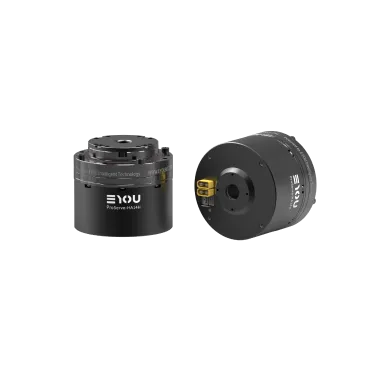
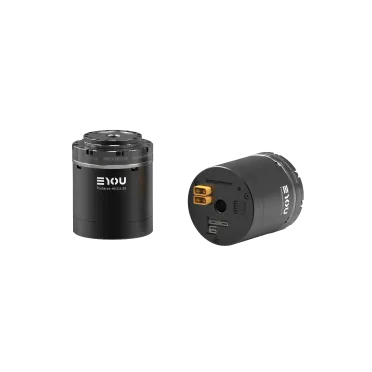
The first three levers save space. The other half of power density starts at the power source. How much copper fits inside the stator slots directly determines torque capability, and the metric is the slot fill factor. Picture the slot as a storage box of fixed size: higher fill means more of the box is working conductor. Industry references put round-wire windings at about 0.35–0.45 slot fill, while hairpin and formed windings reach 0.60–0.80 (Frontiers review). EYOU made targeted improvements to its self-developed motors: the high-power-density motor inside the RP humanoid planetary actuator reaches a slot fill factor above 80%, delivering higher continuous and peak torque in a compact volume.
Cooling: The Hidden Power-Density Lever
Slot fill raises how much torque a motor can produce; cooling decides how much of it can be produced continuously — the dividing line between peak and continuous ratings. Nearly all copper loss turns into heat, and continuous torque is limited by temperature rise, not electromagnetic capability. Research from Sandia National Laboratories quantifies the effect of cooling methods: optimizing housing conduction alone improves heat dissipation by about 50%, forced air by about 79%, and liquid cooling by about 107%; active cooling raises continuous torque density by roughly 15% (Sandia/ASME paper). This also explains why housing design cuts both ways: it is the target of topology optimization and the joint's most important thermal path at the same time.
From Single Upgrades to System-Level Optimization
High power density never comes from one component upgrade alone. Coaxial integration saves axial space, reducer miniaturization saves transmission volume, topology optimization saves structural weight, and slot fill with cooling lifts power output — and the four levers interlock: housing weight reduction must not sacrifice heat dissipation, and higher integration raises heat density. EYOU is pushing every one of these points to its limit and assembling them into a complete whole.
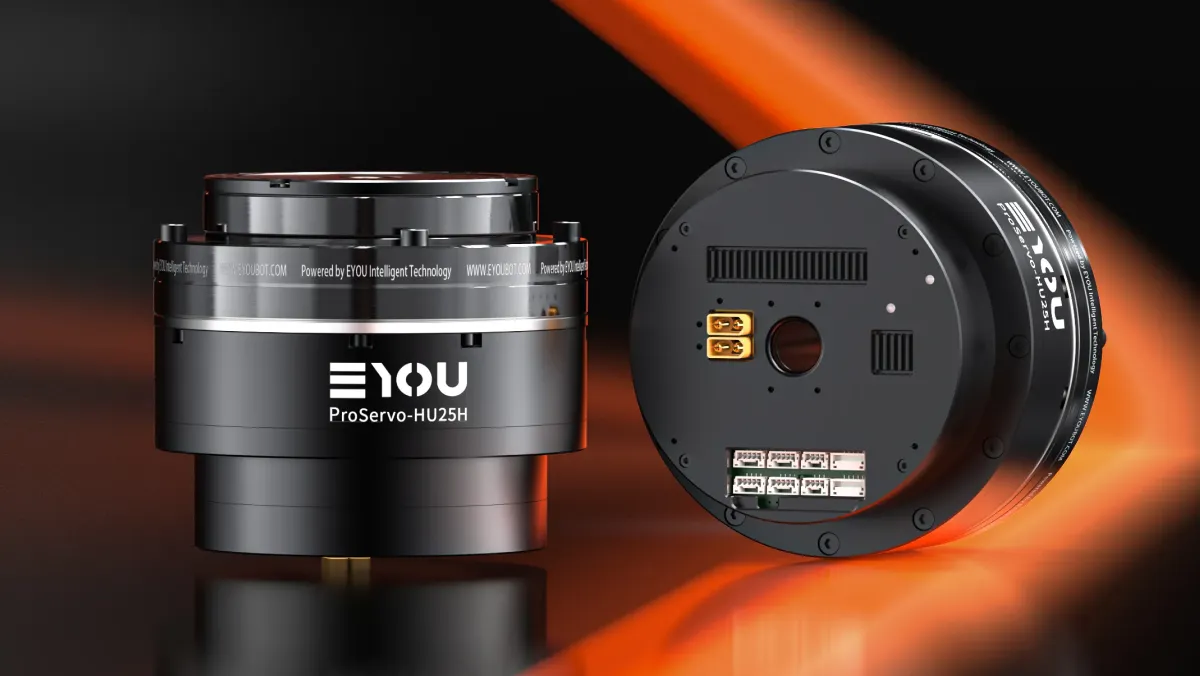
All four levers are already in mass-produced products: the RHU humanoid harmonic actuator achieves 30% smaller volume at equal torque through coaxial integration, and the RP humanoid planetary actuator delivers high continuous torque with a motor slot fill factor above 80%. For what sits inside a joint, see What Is Inside a Robot Actuator. If you are selecting joints for a humanoid or a collaborative arm, send your torque, volume, and weight constraints to our application engineers.
FAQ
Power equals torque times angular velocity (P = T·ω). Power density measures power output per unit of weight or volume; torque density measures torque per unit of weight or volume (Nm/kg or Nm/L). Because robot joints operate mostly at low speed and high torque, torque density is the more common engineering metric. The two terms are often used interchangeably, so align the definitions before comparing numbers.
Measured values from academic research offer a reference: MIT's quasi-direct-drive work reported about 27 Nm/kg saturation torque density for a custom motor versus about 9 Nm/kg for a commercial equivalent, and a coaxial integrated joint prototype published by HKUST(GZ) in 2026 measured about 35.7 Nm/kg for the complete module. For an integrated joint module, above 30 Nm/kg can be considered current first-tier territory — and peak versus continuous torque must be distinguished when comparing.
Four main routes: adopt a large-diameter, flat layout (torque density scales with roughly r0.8 of the air-gap radius); raise the slot fill factor to fit more copper into the same stator; optimize the electromagnetic design to gain torque at the same copper loss; and improve cooling to pull continuous torque closer to peak torque. Beyond the motor, reducer miniaturization and housing weight reduction determine power density at the module level.
Slot fill factor is the share of a stator slot's total area occupied by copper conductors — how well the limited space is used by working material. Industry reference ranges are about 0.35–0.45 for conventional round-wire windings and 0.60–0.80 for hairpin or formed windings. Higher fill means greater current-carrying capacity and torque capability in the same volume. The motor in EYOU's RP humanoid planetary actuator exceeds 80% slot fill.
Not necessarily. Slot fill raises the ceiling of torque capability, but sustained output is thermally constrained: copper loss becomes heat, and once the temperature limit is reached, the motor must be derated. High slot fill only converts into continuous torque when paired with thermal design — housing conduction, forced air, or liquid cooling. Otherwise the gain shows up only in short-term peak torque.
They follow different routes. A harmonic reducer achieves 30:1 to 320:1 reduction in a single compact stage with near-zero backlash, leading in torque density per volume and suiting upper-body and lighter joints. A planetary gearbox offers better rigidity, impact resistance, and efficiency, suiting hips, knees, and ankles that absorb ground impacts. Real humanoids typically mix both by joint position.
Because joints in a humanoid stack in series: every upper-body joint lifts all the joints downstream of it, and the leg joints carry the whole machine. Each gram of joint weight is multiplied upstream, and across twenty to thirty joints the total directly decides the robot's weight, battery life, and payload. A humanoid without sufficient power density ends up either heavy and short-lived, or weak in payload.