What Is a Harmonic Drive? How Strain Wave Gears Power Robot Joints
Inside the precision joints of nearly every modern robot sits a harmonic drive. It is small, but it decides whether a joint can achieve near-zero backlash and high precision. This article explains what a harmonic drive is, how it works, and why robots in particular depend on it.
What Is a Harmonic Drive?
A harmonic drive is a precision reduction device that transmits motion through the elastic deformation of metal. Its technical name is the strain wave gear. It achieves reduction ratios of tens to hundreds in a single, thin, compact stage, with almost no backlash. "Harmonic Drive" is actually a trademark of the Japanese company Harmonic Drive Systems; the technology was invented by U.S. engineer C. Walton Musser in the 1950s, and "harmonic" has since become the common name for this type of reducer.
A robot joint needs exactly the qualities it offers: turning the motor's high speed into low speed and high torque in a tiny space, extremely high positioning accuracy, and almost no lost motion. That is why precision joints from industrial arms to humanoid robots almost all use harmonic drives.
The Three Components of a Harmonic Drive
A harmonic drive has a very simple structure with just three core parts:
- Wave Generator: An elliptical cam fitted with a thin-walled flexible bearing around it. It connects to the motor shaft and is the power input.
- Flexspline: A thin-walled flexible steel cup with external teeth. It is the heart of the reducer and the only part that deforms. It usually serves as the output.
- Circular Spline: A rigid internal ring gear fixed to the housing. It has two more teeth than the flexspline.
Just these three parts, with no complex multi-stage gear stack. This simplicity is exactly why a harmonic drive can be so compact and light.
How Does a Harmonic Drive Work?
Its working principle relies not on the rigid meshing of conventional gears, but on the elastic deformation of metal. It takes a bit of imagination to picture:
- The wave generator is elliptical, and it forces the flexspline around it into an elliptical shape too.
- At the two ends of the ellipse's major axis, the flexspline teeth are pushed out and mesh with the circular spline; along the minor axis, they fully disengage.
- As the wave generator (connected to the motor) rotates, the position of the major axis rotates with it, and the meshing point between flexspline and circular spline moves along.
- Here is the key: the flexspline has two fewer teeth than the circular spline. For every half turn of the wave generator, the flexspline moves one tooth relative to the circular spline; for a full turn, two teeth.
In other words, when the motor turns one full revolution, the output (flexspline) advances only by "two teeth" of distance. This tiny relative movement produces a very large reduction. The reduction ratio equals the flexspline tooth count divided by the tooth-count difference. For example, a 200-tooth flexspline with a difference of 2 gives 100:1, all in a single stage.
Because the teeth in the meshing region are always fully engaged, there is almost no gap between teeth. So a harmonic drive has near-zero backlash by nature. This is the root of its high precision.
Why Robots in Particular Depend on Harmonic Drives
Robot joints place a set of demanding and rather special requirements on a reducer, and the harmonic drive is almost tailor-made for them.
Near-Zero Backlash for Accurate Positioning
A robot's end-effector accuracy is magnified by the backlash accumulated at each joint. A harmonic drive's near-zero backlash (typically ≤15 arcsec) ensures no lost motion when a joint reverses, the precondition for an arm to grasp accurately and a humanoid to move steadily. Ordinary gearboxes cannot reach this level.
High Single-Stage Reduction for a Compact Structure
Robot joint space is extremely limited, especially in a humanoid's wrist and elbow. A harmonic drive achieves a 50:1 to 160:1 reduction in a single, axially short stage, while a planetary gear set would need three or four stages to match. The more compact the structure, the smaller and lighter the joint can be.
High Torque Density for Strong Yet Light Joints
Many teeth share the load during harmonic meshing, giving high torque density. This lets a joint output enough torque at very low weight, which is critical for robots that must manage their own mass.
Hollow Structure for Easy Cable Routing
Modern harmonic joints often use a hollow design, letting cables, signal wires, and even pneumatic lines pass through the center. For humanoid robots with dense wiring, this greatly simplifies the whole machine's cable layout.
The Trade-Off: When Not to Use a Harmonic Drive
A harmonic drive is not a cure-all. Its biggest weak point is the flexspline. That thin-walled steel cup deforms repeatedly over time and will fatigue under sustained impact loads, limiting its life. So joints that absorb ground impact (such as a humanoid's knee and ankle) are better served by an impact-resistant planetary reducer than by a harmonic drive.
A complete humanoid robot usually combines both: harmonic actuators for the precision-demanding upper-limb joints, and planetary actuators for the impact-bearing lower-limb joints. Selection comes down to what a given joint needs most.
EYOU Harmonic Joint Actuators
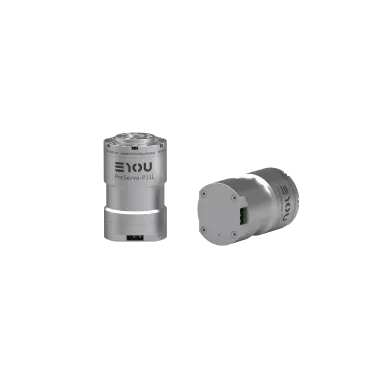
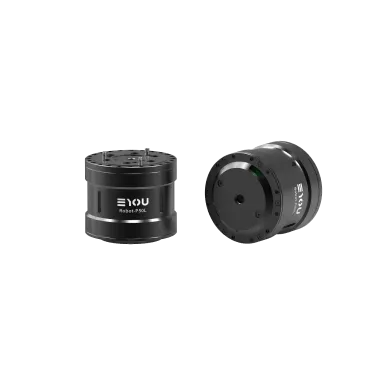
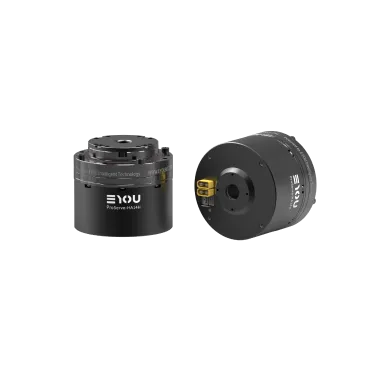
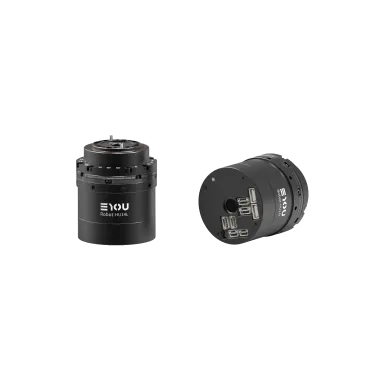
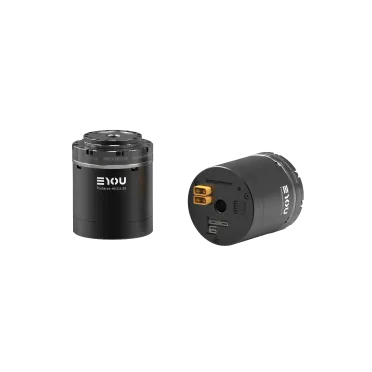
EYOU Robot integrates the harmonic drive with a frameless torque motor, 19-bit dual absolute encoders, and a servo driver in one housing, making an integrated harmonic joint actuator. Bolt it on and it is a complete joint drive unit. There are three harmonic product lines for different scenarios:
- PHU Enhanced Harmonic Joint Module: General-purpose, covering the full φ40–170mm size range, supporting EtherCAT/CAN FD dual protocols, with optional force control.
- RHU Humanoid Harmonic Joint Module: Large hollow bore and potting heat dissipation, built for humanoid robots, 30% smaller than conventional designs.
- PHA Lightweight Harmonic Joint Module: Ultra-light, as low as 207g, for weight-sensitive upper limbs and lightweight arms.
All three lines build on the high precision and near-zero backlash of harmonic transmission, differing in how they are optimized for specific joint scenarios. Tell us your joint requirements and we will help you pick the right model.
FAQ
Yes, they are the same thing. Strain wave gear is the technical name for the technology; "Harmonic Drive" was originally a trademark of the Japanese company Harmonic Drive Systems, and because it became so common, people now call this whole class of reducers harmonic drives. The three names refer to the same device.
The reduction ratio equals the flexspline tooth count divided by the tooth-count difference between the flexspline and circular spline. When the flexspline has two fewer teeth than the circular spline, the flexspline moves only two teeth per full turn of the wave generator. For example, a 200-tooth flexspline with a difference of 2 gives 200÷2 = 100:1. Achieving this large reduction in a single stage is one of the harmonic drive's biggest advantages.
Because during harmonic meshing, many teeth at both ends of the major axis are fully engaged at the same time, with almost no gap between them. Conventional gears transmit through a few teeth in point contact, which inevitably leaves a gap (backlash). The harmonic drive's multi-tooth full engagement structurally eliminates this gap, so backlash can reach the arcsecond level, far lower than an ordinary gearbox.
Neither is absolutely better; it depends on the joint's needs. A harmonic drive has near-zero backlash, high precision, and a compact structure, suited to precision-demanding upper-limb joints (shoulder, elbow, wrist). A planetary reducer has higher torque density and stronger impact resistance, suited to impact-bearing lower-limb joints (hip, knee, ankle). Humanoid robots usually use harmonic on top and planetary on the bottom, combining the two.
Mainly flexspline fatigue. The flexspline is a thin-walled steel cup that goes through a full elliptical deformation every revolution, and repeated deformation over time causes fatigue. Factors that shorten life include sustained operation above rated torque, high-speed impact loads, insufficient lubrication, and operating outside the rated temperature range. Used correctly within rated load and maintained with regular lubrication, life extends significantly. EYOU harmonic joints have a rated service life of over 8,000 to 10,000 hours.