The Evolution of Robot Actuator Manufacturing: From Hand-Built to Fully Automated
A robot joint actuator's performance is decided by its design, but its consistency, cost, and deliverability are decided by how it is manufactured. A single humanoid robot needs 30 to 60 joint actuators, which means volume production of humanoids translates into millions of joints per year. Whether the industry can build them — and build every single one to the same standard — has become the dividing line. Over the past decade, robot actuator manufacturing has moved through three stages.
Stage One: Hand-Built (Before 2015), When a Joint Was a "Piece of Work"
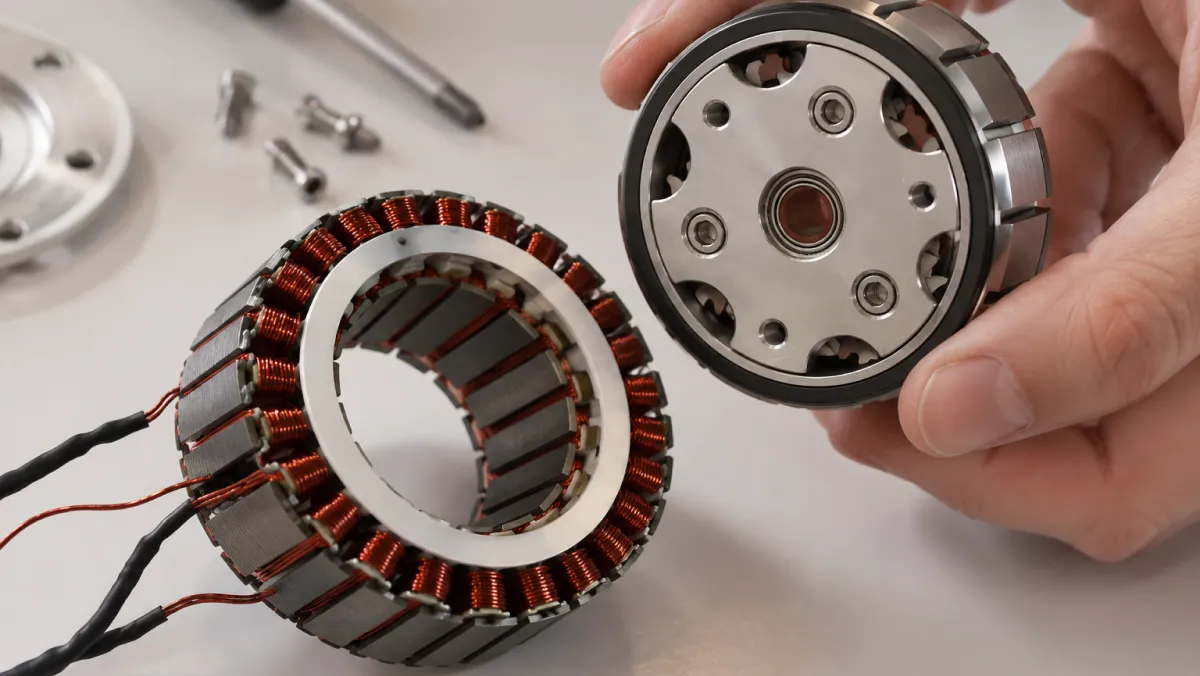
Early joint manufacturing revolved around people. Engineers assembled and tuned each unit at a workbench: reducer preload, adhesive application, sensor alignment, and calibration all depended on feel and experience. This approach could produce excellent samples, but it had two structural problems. The first was capacity — a workshop organization has a hard ceiling on output. The second was consistency — units built by different hands on different shifts simply behaved differently. A joint from this era was closer to a piece of craftsmanship than an industrial product.
Stage Two: Semi-Automation (From 2016), Automated Machines on a Manual Line
To move toward commercial production, manufacturers began optimizing joint designs and key processes. Stations that demand high force and repeatability — adhesive dispensing, screw tightening, press-fitting — were progressively equipped with standalone automated machines, giving process quality machine-level guarantees for the first time. But the links between stations stayed manual: material handling and loading still depended on people. The machines were automated; the line was not. Manual transfer re-introduced variation between processes, consistency was lost between stations, and throughput stalled at the handoffs. The industry remained semi-automated.
Stage Three: Full Automation (From 2026), the World's First Automated Robot Joint Production Line
In early 2026, EYOU Robot commissioned the world's first automated robot joint production line in Shanghai's Zhangjiang Robot Valley, bringing joint manufacturing into the fully automated era. Construction started in February 2025, automation equipment moved in during October, the first unit rolled off the line on December 31, and the line passed final acceptance on January 15, 2026 before officially launching on January 21.
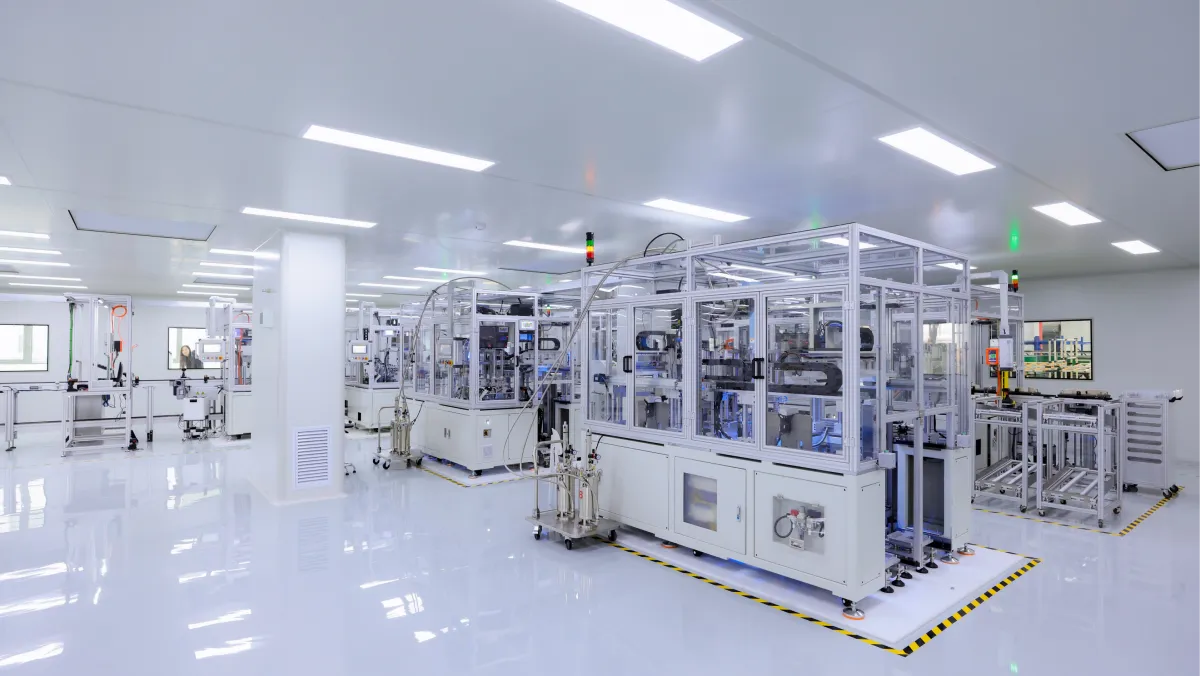
The line connects precision assembly, automatic calibration, and performance testing into one unbroken flow — unmanned from assembly and testing through packaging, with material flow and data flow fully integrated. Cycle time was compressed from 90 seconds during ramp-up to 60 seconds, the automation rate reaches 85%, and the first-pass yield exceeds 98%. Every joint is 100% inspected and traceable from order to outbound delivery. A full-process digital twin collects and analyzes production data in real time, driving scheduling optimization and quality decisions, and the entire operation follows automotive-grade management standards across production, process, material control, and quality. The Zhangjiang line starts at 100,000 units per year with a target of 150,000; EYOU's total capacity stands at 300,000 units today with another 700,000 under construction.
From Requirements to Mass Production: The Five Stages Every Joint Completes
The automated line answers "how to build." The quality closed loop answers "what to build and what qualifies it for volume production." In EYOU's quality system, every joint passes through five stages from requirement analysis to volume delivery, each with a defined deliverables list:
| Stage | Volume | Key Deliverables |
|---|---|---|
| Product requirement analysis | 0 pcs | Design specification, customer requirement breakdown, magnetic/stiffness simulation, 3D/2D models, CC/SC list, tooling requirement list, DVP test plan, DFMEA |
| Product development & validation | 10–300 pcs | Trial assembly and inspection instructions, project issue list, incoming inspection records, sub-supplier list, trial assembly report (including joint tuning), test report, lessons learned |
| Product optimization & improvement | 30–1000 pcs | Process flow chart, PFMEA, equipment/tooling/gauge list, inspection instructions, issue list, incoming inspection records, sub-supplier list, trial assembly and test reports, lessons learned |
| Mass production transfer | 1000 pcs | Product specification/PFMEA, 2D/3D/software/hardware layout, process validation checklist, mass-production SOP and SIP, equipment/tooling/gauge list, control plan, line layout, packaging plan, production supplier list, transfer meeting minutes |
| Product maturity cultivation | Volume | Maturity cultivation plan, process optimization plan, after-sales quality plan, user manual |
Only when the first four stages close their loops does a joint enter volume production — and maturity cultivation continues to track process optimization and after-sales quality afterward. Mass production is not a one-time release; it is a continuously controlled state.
The Three Stages at a Glance
| Stage | Period | Production Mode | Consistency Control | Capacity Profile |
|---|---|---|---|---|
| Hand-built | Before 2015 | Manual assembly and tuning at engineering workbenches | Relies on individual experience, no process control | Workshop scale, limited output |
| Semi-automated | From 2016 | Standalone automation for dispensing, tightening and press-fitting; manual handling between stations | Controlled at single points; variation re-enters through manual transfer | Small batches possible, hard to scale |
| Fully automated | From 2026 | Precision assembly, auto calibration and performance testing connected end to end; material and data flow fully integrated | Full-process SPC, 100% inspection, complete traceability | 60-second cycle time, 100k–150k units per line per year |
What the Evolution Really Means: Cost and Time Are the Goal, Not the Essence
Discussions of automation usually land on cost reduction and efficiency. But cost and time benefits are not the essence of smart, automated manufacturing — they are the goal. The essence is a higher standard, higher precision, and higher performance: only sufficient quality control makes automated volume production possible, and only automated volume production can reproduce that high standard on every single unit. The hand-built era depended on a master's touch, the semi-automated era on machine accuracy at single stations, and the fully automated era on the engineering capability of the entire manufacturing system.
Every gain in cost, time, and performance accelerates the whole industry. McKinsey estimates actuators account for 40 to 60 percent of a humanoid robot's bill of materials, the largest cost block. TrendForce projects China's humanoid robot output will nearly double in 2026, and Goldman Sachs forecasts the global humanoid market could reach about $38 billion by 2035. Volume production of complete robots presupposes that core components can keep pace — and it is manufacturing breakthroughs like the automated mass production of robot joint actuators that are driving the industry's gains in quality, cost, and efficiency.
Closing Thoughts
From the workbench to the automated line, the three stages of robot actuator manufacturing measure the distance between a part and an industrial product. For robot OEMs, the criteria for evaluating joint suppliers have changed with them: peak sample specs are no longer enough — consistency control, end-to-end traceability, and automated capacity reserves matter just as much. EYOU Robot delivered 95,000 joint modules in 2025, ranking first in harmonic joint shipments for humanoid robots in China, with harmonic, planetary, and linear product lines covering every joint position on a humanoid. If you are evaluating joint supply, see our harmonic and planetary series, or send your requirements to our application engineers.
FAQ
EYOU Robot is currently the only manufacturer with a publicly commissioned fully automated robot joint production line — the Zhangjiang, Shanghai line officially launched in early 2026, and the company delivered 95,000 joint modules in 2025. Other major players are still building: LG plans to complete a fully automated actuator line in Changwon, South Korea by the end of 2026, and the Stabilus-Synapticon joint line only starts European small-series production in 2027. Most joint suppliers remain at the hand-built or semi-automated stage.
A complete automated joint line typically includes automated component feeding, motor assembly, reducer integration, module final assembly, automatic tightening, vision inspection, automatic calibration and performance testing, laser marking, and data collection with full traceability throughout. EYOU's Zhangjiang line connects all of these into one unbroken flow, unmanned from assembly and testing through packaging.
Four things. First, consistency: assembly variation that manual work cannot control is taken over by full-process control, pushing first-pass yield above 98%. Second, capacity: a 60-second cycle time and 100,000 to 150,000 units per line per year let joint supply keep pace with robot production ramps for the first time. Third, traceability: every joint is traceable from order to outbound delivery, so field issues can be pinpointed to a process and a batch. Fourth, cost: scale and automation keep diluting unit cost, turning high-performance joints into industrial products that can be procured in volume.