Types of Robot Joint Actuators: A Practical Guide to Harmonic, Planetary, and Beyond
If you are selecting joint actuators for a robot — whether it is a humanoid, a cobot arm, or an industrial machine — the gear type inside the actuator is the single most important decision you will make. It determines torque capacity, precision, size, impact tolerance, cost, and service life. This guide breaks down the main types of robot joint actuators used in the industry today, with a focus on the two most common: harmonic drive and planetary gear.
What Is a Robot Joint Actuator?
A robot joint actuator is a self-contained module that drives rotation at a single joint. In its most integrated form, it combines a motor, gear reducer, encoder, driver electronics, and sometimes a brake into one housing. You bolt it into the robot structure, connect power and communication, and it handles everything from torque output to position feedback. The gear reducer is the core differentiator between actuator types — it defines the actuator's mechanical personality.
The Main Types of Robot Joint Actuators
There are five gear-based actuator types commonly seen in robotics today. Each has distinct mechanical characteristics that make it better suited for certain joints and applications.
1. Harmonic Drive (Strain Wave Gear) Actuators
A harmonic drive uses three components: an elliptical wave generator, a thin-walled flexible steel cup (flexspline) with external teeth, and a rigid outer ring (circular spline) with internal teeth. The wave generator deforms the flexspline into an ellipse, forcing its teeth to engage with the circular spline at two points. Because the flexspline has two fewer teeth than the circular spline, each rotation of the wave generator advances the output by a tiny amount — producing reduction ratios of 50:1 to 160:1 in a single compact stage.
Key characteristics:
- Near-zero backlash (typically ≤15 arcsec)
- High positioning accuracy
- Compact and lightweight at high reduction ratios
- Best for: upper-body robot joints requiring precision — shoulders, elbows, wrists
- Limitation: the flexspline is sensitive to sustained impact loads
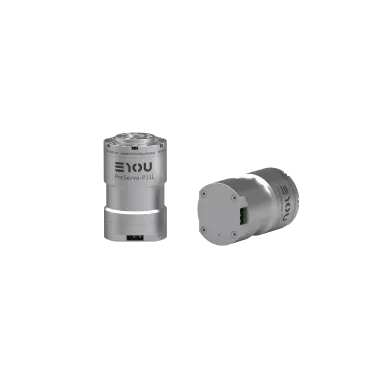
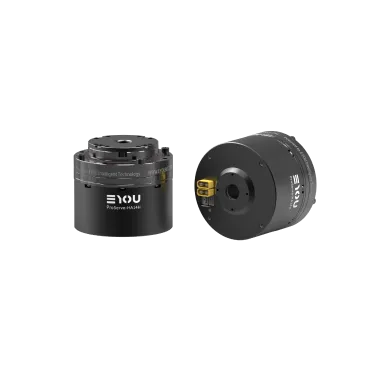
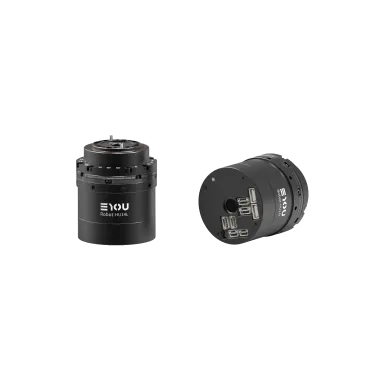
Harmonic actuators are the most widely used joint type for humanoid robot upper limbs and collaborative robot arms. The industry consensus is clear on this point. At EYOU Robot, our PHU Enhanced Harmonic Drive series covers 10 models from φ40mm to φ170mm. For humanoid-specific applications requiring large hollow bores for internal cable routing, the RHU Humanoid Harmonic Drive series offers up to 22mm hollow bore diameter. Where weight is the top priority, the PHA Lightweight series starts at just 207g.
2. Planetary Gear Actuators
A planetary gearbox uses a central sun gear surrounded by multiple planet gears, all enclosed within an outer ring gear. The planet gears mesh simultaneously with both the sun gear and ring gear, distributing the load across multiple tooth contacts. This multi-point load sharing is the reason planetary actuators handle high torque and impact loads well.
Key characteristics:
- High torque density relative to size
- Good impact and shock resistance
- Higher backlash than harmonic (typically ≥12 arcmin)
- Lower reduction ratios per stage (typically 3:1 to 10:1 per stage, 20:1 to 100:1 in multi-stage)
- Best for: lower-body joints on humanoid robots, high-load joints, performance robots
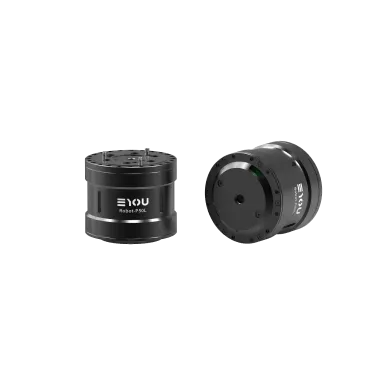
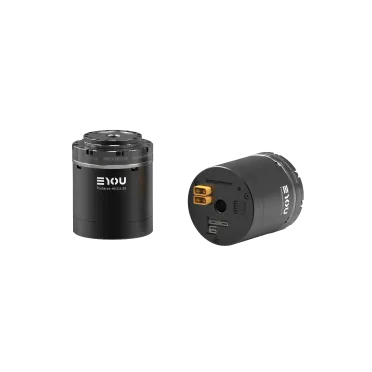
Planetary actuators are the standard choice for humanoid robot legs — hips, knees, and ankles — where ground impact during walking and running creates repeated shock loads that harmonic flexsplines cannot tolerate long-term. EYOU Robot offers two planetary lines: the RP Humanoid Planetary series for full-size humanoid lower limbs (48V, up to 120 N.m peak torque), and the PP Compact Planetary series for lifelike and performance robots (24V, as small as 32mm/86g).
3. Cycloidal (RV) Actuators
A cycloidal reducer uses an eccentric cam to drive a cycloidal disc whose lobes engage with pins arranged in a ring. The disc wobbles rather than rotates concentrically, and the difference in lobe count versus pin count produces the reduction. RV reducers combine a first-stage planetary reduction with a second-stage cycloidal mechanism.
Key characteristics:
- Very high rigidity and shock resistance
- Higher torque capacity than harmonic at comparable sizes
- Larger and heavier than harmonic drives
- Best for: heavy-duty industrial robot arms (base and shoulder joints on 6-axis robots)
Cycloidal/RV reducers dominate the traditional industrial robot market (the large 6-axis arms from Fanuc, ABB, KUKA). They are less common in humanoid robots due to their size and weight, though some manufacturers are exploring compact cycloidal designs for legged robots.
4. Quasi-Direct Drive (QDD) Actuators
QDD actuators use a very low gear ratio — typically 6:1 to 10:1 — paired with a large, high-torque-density motor. The low gearing means the motor's rotor inertia is not amplified much through the gear train, giving the joint high backdrivability. Push the joint by hand, and it moves easily. This makes QDD joints inherently compliant and safe for contact.
Key characteristics:
- Excellent backdrivability and force transparency
- Fast dynamic response
- Lower torque output per unit weight (the motor must be large to compensate for low gearing)
- Best for: legged robots prioritizing agile locomotion, quadrupeds, research platforms
QDD is popular in quadruped robots (like MIT Mini Cheetah) and some research humanoids. The trade-off is that QDD joints need bigger, heavier motors to produce the same output torque as a high-ratio geared actuator. For applications where holding torque, precision positioning, or compact size matter more than backdrivability, harmonic or planetary actuators are the better fit.
5. Direct Drive (DD) Actuators
Direct drive means no gearbox at all — the motor shaft is the joint output. This eliminates all gear-related backlash, friction, and compliance. The motor must produce full output torque on its own, which means very large, heavy, and expensive motors.
Key characteristics:
- Zero backlash, zero gear friction
- Perfect force transparency
- Very large and heavy for a given torque output
- Best for: high-end haptic devices, precision measurement equipment, research applications with low torque requirements
Direct drive is rare in production robots due to the size and cost penalty. It appears mainly in research labs and specialized haptic/teleopertion hardware where force fidelity is the top priority.
Side-by-Side Comparison
| Type | Reduction Ratio | Backlash | Torque Density | Impact Resistance | Backdrivability | Typical Application |
|---|---|---|---|---|---|---|
| Harmonic Drive | 50:1 – 160:1 | ≤15 arcsec | High | Moderate | Low | Cobot arms, humanoid upper body |
| Planetary Gear | 20:1 – 100:1 | ≥12 arcmin | Very high | Excellent | Moderate | Humanoid legs, performance robots |
| Cycloidal / RV | 30:1 – 180:1 | ≤1 arcmin | Very high | Excellent | Low | Industrial robot base/shoulder |
| Quasi-Direct Drive | 6:1 – 10:1 | Low | Low | Good | Excellent | Quadrupeds, agile legged robots |
| Direct Drive | 1:1 | Zero | Very low | N/A | Perfect | Haptics, precision research |
How to Choose: Matching Actuator Type to Joint Requirements
The selection comes down to what the specific joint needs most. Here is a practical decision framework:
- Need high precision + compact size? → Harmonic drive. This is the default for cobot arms and humanoid upper limbs.
- Need high torque + impact resistance? → Planetary gear. Standard for humanoid legs and any joint that faces repeated shock loads.
- Need maximum rigidity for heavy payloads? → Cycloidal/RV. The go-to for large industrial robot arms.
- Need backdrivability + agile locomotion? → QDD. Ideal for research quadrupeds and legged platforms prioritizing dynamic movement.
- Need zero backlash + perfect force transparency? → Direct drive. Only when torque requirements are low and budget is not constrained.
Many robots use a combination. A full-size humanoid typically uses harmonic actuators for upper-body precision joints and planetary actuators for lower-body power joints. This is the approach we take at EYOU Robot — our product line includes both harmonic (PHU, RHU, PHA) and planetary (RP, PP) series specifically to cover full-body joint requirements from a single supplier.
Why Harmonic and Planetary Dominate the Humanoid Robot Market
The humanoid robot industry has largely converged on a harmonic-upper / planetary-lower architecture. The reasons are straightforward:
- Upper limbs need precision for manipulation tasks. Harmonic drives deliver ≤15 arcsec backlash in a compact package — no other gear type matches this at the same size.
- Lower limbs face ground reaction forces during every step. Planetary gears distribute load across multiple teeth and handle transient shock spikes that would fatigue a harmonic flexspline over time.
- Both types can be packaged as integrated actuator modules with motor, encoder, driver, and brake in one unit — simplifying robot assembly.
- Supply chains for both types are mature and scaling. In 2025, EYOU Robot alone delivered 95,000 joint module sets across harmonic and planetary lines.
Get Started
If you are evaluating joint actuators for your robot project, start by mapping each joint's torque, speed, precision, and size requirements. Then match to the actuator type that fits. For harmonic and planetary integrated joint modules, explore our full product range:
- PHU Enhanced Harmonic Drive Robot Actuator — general-purpose, 10 models, φ40–170mm
- RHU Humanoid Harmonic Drive Robot Actuator — humanoid-specific, up to 22mm hollow bore
- PHA Lightweight Harmonic Drive Robot Actuator — weight-optimized, from 207g
- RP Humanoid Planetary Robot Actuator — humanoid lower limbs, 48V, up to 120 N.m peak
- PP Compact Planetary Robot Actuator — lifelike/performance robots, from 32mm/86g
FAQ
The most common combination is harmonic drive actuators for upper-body joints (shoulders, elbows, wrists) and planetary gear actuators for lower-body joints (hips, knees, ankles). For collaborative robot arms, harmonic drive actuators are used at nearly every joint due to their precision and compact size. This harmonic-upper / planetary-lower split is the current industry standard for full-size humanoid robots.
Yes, and most full-size humanoid robots do exactly this. The upper body uses harmonic actuators for precision manipulation, while the lower body uses planetary actuators for impact resistance and high torque during locomotion. EYOU Robot provides both harmonic (PHU, RHU, PHA) and planetary (RP, PP) series specifically so that robot builders can source full-body joints from a single supplier with unified software tools and communication protocols.
Both achieve high reduction ratios in a compact package, but through different mechanisms. A harmonic drive deforms a thin flexible cup (flexspline) to create motion — delivering near-zero backlash in an extremely compact form. A cycloidal reducer uses an eccentric wobbling disc engaging with ring pins — offering higher rigidity and shock resistance but in a larger, heavier package. Harmonic drives dominate in cobots and humanoid upper limbs where compactness matters. Cycloidal/RV reducers dominate in heavy industrial robot arms where maximum stiffness is needed.
Neither is universally better — they solve different problems. QDD actuators use very low gear ratios (6:1 to 10:1) to preserve backdrivability, making the joint naturally compliant and safe for contact. Harmonic actuators use high gear ratios (50:1 to 160:1) for high torque multiplication and precise positioning. QDD is better for agile legged locomotion where the robot needs to feel and react to ground contact. Harmonic is better for manipulation tasks, holding positions, and compact joints where space is limited.
Ask three questions about the joint: (1) Does it need high positioning accuracy or will it perform precision tasks? If yes, harmonic. (2) Will it face repeated impact loads — like a leg hitting the ground during walking? If yes, planetary. (3) Does it need to be as compact and light as possible? Harmonic is more compact at the same torque. If the joint needs both precision and some impact tolerance — like a humanoid shoulder — harmonic with appropriate derating is usually the better choice. If cost is the primary constraint for a performance or educational robot, planetary (like the PP series) offers a lower entry point.